Workflow
Iqra’a: Sharjah Libraries & Information Journal
From Submission to Publication
-
Introduction
- The Iqra’a: Sharjah Libraries & Information Journal upholds the highest standards of academic and professional publishing by fostering a collaborative and transparent process for manuscript submission, review, and publication.
- Our workflow is designed to engage authors, reviewers, editors, and publishing staff in a structured and ethical framework, ensuring adherence to the journal's specific standards and scholarly excellence.
- This document provides a guide for all stakeholders involved in the manuscript management process, outlining their roles and responsibilities at each stage.
- By maintaining rigorous ethical guidelines and a commitment to quality, this workflow supports the seamless progression of manuscripts from submission to publication.
- Through this structured approach, the Iqra’a Journal aims to facilitate scholarly communication and contribute meaningfully to the advancement of knowledge in library science, information management, and related disciplines.
-
The Manuscript Journey
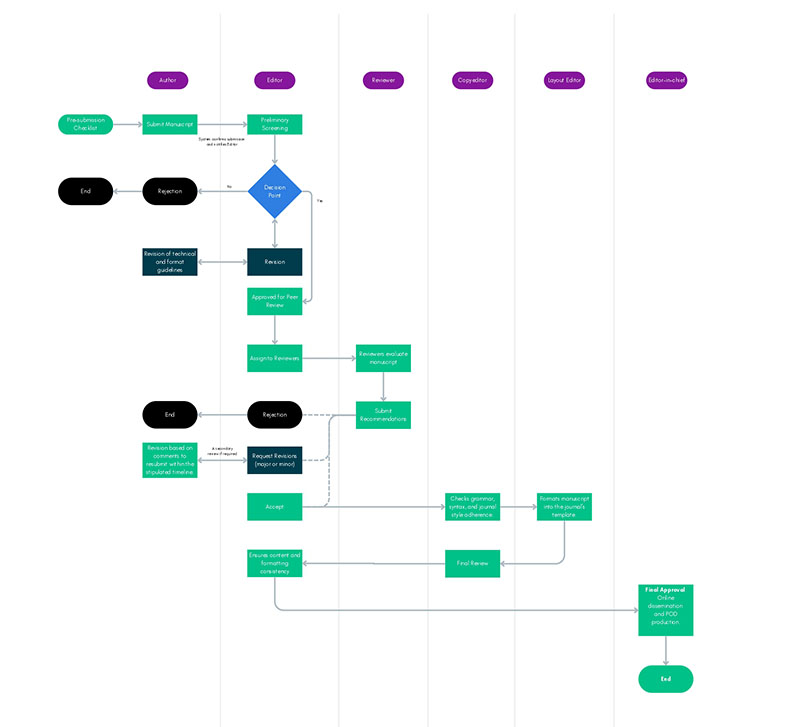
- The following sections outline the step-by-step process for manuscript management, starting with the submission stage.
- Each phase is designed to ensure that manuscripts meet the journal's standards while providing transparent guidance to contributors and stakeholders.
-
1. Author Submission
-
1.1. Pre-Submission Checklist
- Authors ensure adherence to journal-specific guidelines:
- Word count, formatting, file types, and citation style.
- Ethical standards, including conflict-of-interest declarations and plagiarism checks.
-
1.2. Submission via System
- Authors submit the manuscript and supplementary materials (e.g., figures, tables, data files) through the journal’s submission system.
- Submission system confirms receipt and notifies the author and Editor.
-
2. Initial Editorial Review
-
2.1. Preliminary Screening
- The Editor reviews the manuscript for:
- Compliance with technical and formatting guidelines.
- Relevance to the journal’s scope and focus.
- Basic quality of content and originality.
-
2.2. Preliminary Decision
- Based on the initial review:
- Reject outright: If the manuscript is irrelevant, poorly scoped, or low-quality.
- Request revisions: If technical and formatting corrections are needed.
- Assign to Reviewers: If it meets basic criteria for peer review.
-
3. Peer Review Process
-
3.1. Reviewer Expectations
- The Editor communicates:
- Review timelines.
- Evaluation criteria (e.g., originality, methodology, scientific rigor).
-
3.2. Reviewer Assessment
- Reviewers provide detailed feedback on:
- Content relevance and contribution.
- Methodological soundness and data validity.
- Overall scientific soundness.
-
3.3. Reviewer Recommendations
- Reviewers submit feedback with a recommendation:
- Accept.
- Request revisions (major or minor).
- Reject.
-
4. Editorial Decision
-
4.1. Editor Review
- The Editor reviews reviewer feedback and makes a decision:
- Reject: Communicates the decision to the author.
- Request Revisions: Provides detailed feedback for improvement.
- Accept: Approves for the next stage.
-
4.2. Author Revisions
- Authors revise the manuscript based on reviewer and editor comments and resubmit within the stipulated timeline.
- Resubmitted manuscripts undergo a secondary review if required.
-
5. Copyediting
-
5.1. Copyeditor Review
- Once accepted, the manuscript is sent to the Copyeditor, who:
- Checks grammar, syntax, and adherence to the journal’s style guide.
- Ensures proper citation and referencing format.
-
5.2. Revisions if Required
- If issues are identified, the Copyeditor communicates with the author for corrections.
- Final copyedited manuscript is forwarded to the Layout Editor.
-
6. Layout Editing
-
6.1. Manuscript Formatting
- The Layout Editor formats the manuscript into the journal’s publication template, ensuring:
- Consistency in visuals, tables, and references.
- Alignment with journal style and publication standards.
-
6.2. Final Formatting Review
- The formatted manuscript is sent to the Copyeditor for:
- Review of typographical accuracy.
- Check for layout consistency.
-
6.3. Revisions if Required
- The Layout Editor addresses any issues flagged by the Copyeditor.
-
7. Final Editorial Review
-
7.1. Editor Review
- The Editor ensures:
- Content and formatting consistency.
- Compliance with publication standards.
-
7.2. Approval by Editor-in-Chief
- The finalized manuscript is sent to the Editor-in-Chief for:
- Final review and approval for publication.
-
8. Proof Approval
-
8.1. Author Review of Final Proof
- Authors review the final proof to ensure accuracy in content and formatting.
- Authors confirm corrections, if any, are applied.
-
9. Publication
-
9.1. Final Steps
- Approved manuscripts are:
- Disseminated online.
- Prepared for Print-on-Demand (POD) production, if applicable.
-
9.2. Post-Publication Corrections
- If errors are identified after publication:
- Errata or corrigenda are issued.
- Retraction policies are applied as necessary.
-
Final Note
- We appreciate the dedication of all contributors to this mission and encourage continued engagement with our journal.
- By adhering to this workflow, we ensure that every publication reflects the values of excellence, integrity, and scholarship that define Iqra’a.
- Thank you for your commitment to upholding the standards and vision of our journal.
- We look forward to your contributions to advancing the field.