

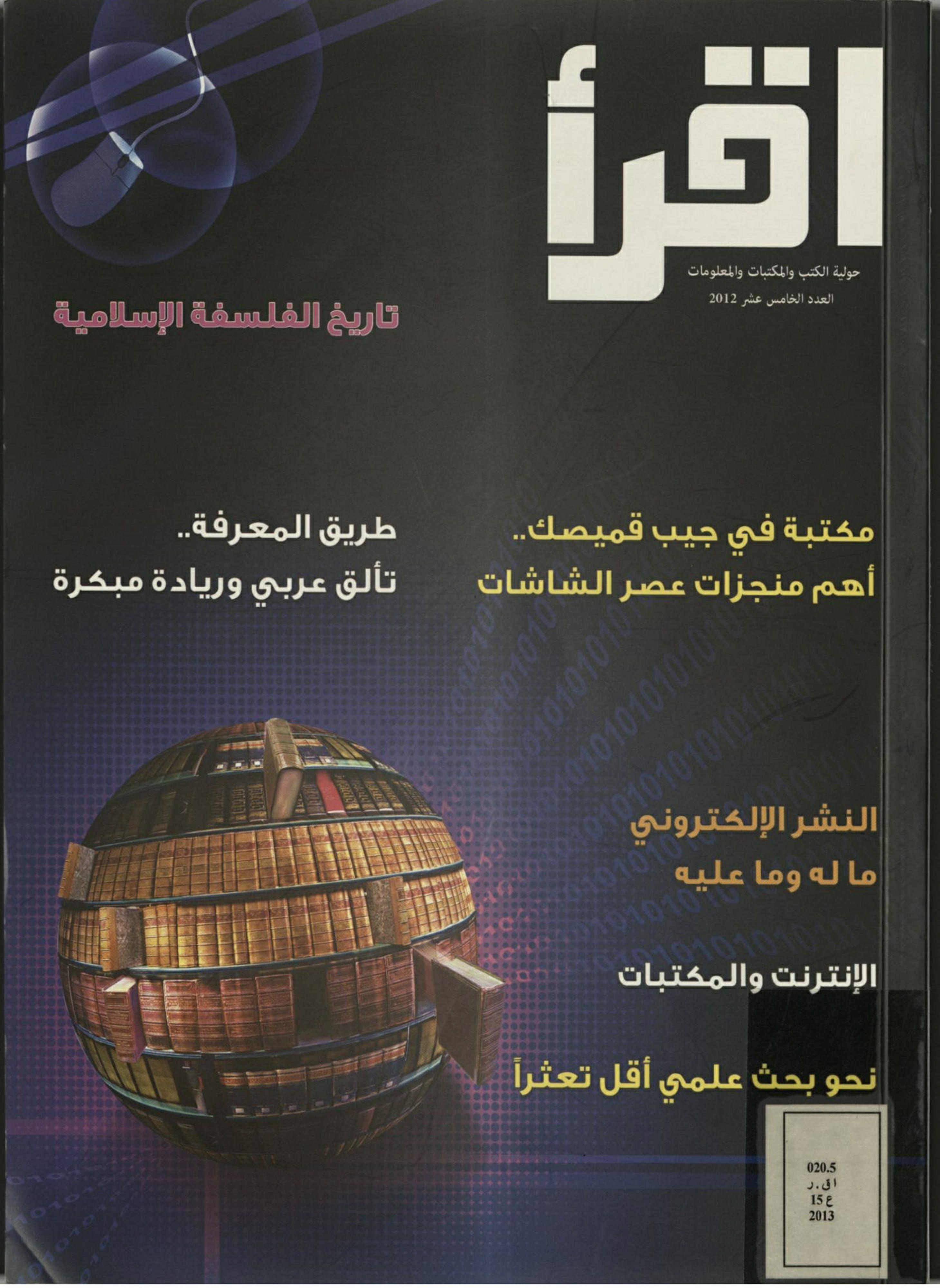
- Library & Information Science
- Digital & Electronic Libraries
- Electronic Publishing
- Internet, Web & Information Technologies
- Information Networks & Resource Sharing
- Higher Education & Research
- Arab World
- National Information Strategies
- National Information Policy
- E-Government & E-Commerce
- Digital Divide & Information Development
- Knowledge Economy & Information Industry
Published 2026-06-07
Keywords
- Information Economics,
- Arab Information Reality,
- Information Society,
- Knowledge Economy,
- Information Technology
- Digital Divide,
- Information Industry,
- Information Services,
- Information Infrastructure,
- Information Policies,
- Information Networks,
- Internet in the Arab World,
- E-Government,
- E-Commerce,
- E-Learning,
- Arab Information Development ...More
Abstract
This article examines information economics as a major framework for understanding contemporary knowledge-based and economic transformations, with particular attention to the position of the Arab world within these changes. It begins by defining information, its characteristics, and its value, showing how information has shifted from being a supporting element in administration and research to becoming an economic and strategic resource linked to production, development, and competitiveness. The article then discusses the emergence of the knowledge economy, the information industry, and information services, highlighting the role of information and communication technologies in reshaping institutions, markets, education, work patterns, and cultural exchange. It further analyzes the Arab information reality by identifying manifestations of the digital divide, weak infrastructure, limited Arabic digital content, uneven Internet penetration, and challenges related to policy, legislation, and human resources. The article also reviews Arab initiatives in information networks, e-government, e-commerce, and e-learning, while noting the economic, organizational, and cultural obstacles they face. It concludes that building an effective Arab information environment requires a comprehensive strategy that invests in people, infrastructure, legislation, content production, and the integration of information into development projects.